Judge orders Google to make rival app store installs easier

For all those whose filter blocks that page or it requires login

‘That is not acceptable’: Judge orders Google to make rival app store installs easier

Judge Donato was not having Google’s ‘anticompetitive friction.‘

by Sean Hollister

Aug 13, 2026, 9:53 PM UTC

One month after Epic Games and Google seemingly stopped fighting over the future of Android app distribution, they were back in a San Francisco courtroom today — where Judge James Donato just ordered Google to make it easier to install rival app stores on Android.

It’s been nearly three years since a jury unanimously decided that Google had an illegal monopoly over Android apps, and almost two years since Judge Donato decided the best way of undoing that monopoly would be to crack open Android app distribution. Donato ordered Google to carry rival Android app stores inside its own Google Play Store, and to provide rivals with complete access to Google’s full catalog of apps, for several years.

But Epic argued that Google is still making it too difficult to install rival app stores, showing the entire courtroom a live demo of how many steps it currently takes — and Judge Donato agreed that some of those steps were unnecessary “anticompetitive friction” and ordered Google to remove them.

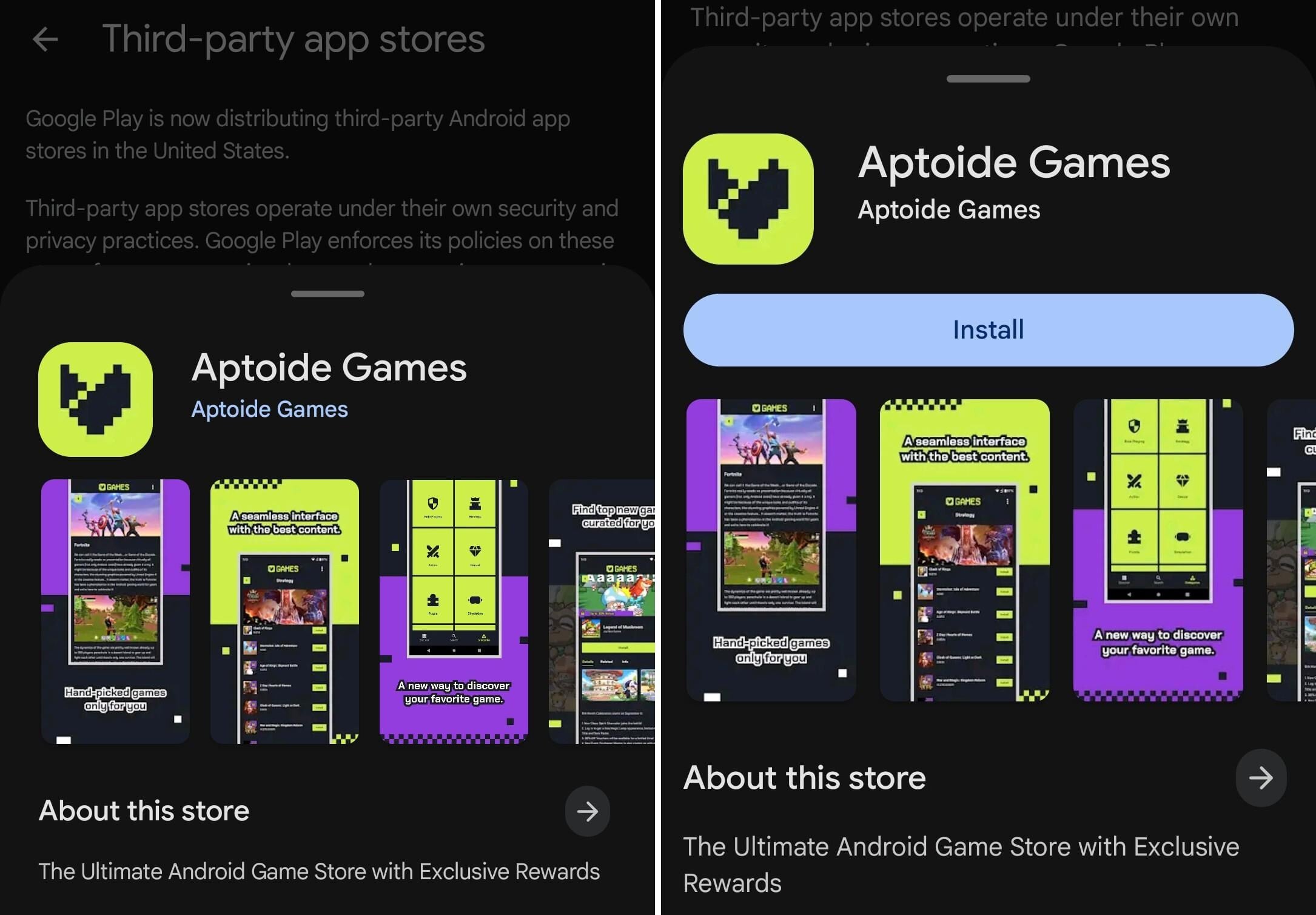
First, Epic’s lawyer Yonatan Even showed that if you search Google’s Play Store for the term “store for apps,” no third-party app stores appear, only physical stores. “Wait, why did Walmart come up?” Judge Donato asked. “That’s not good,” he exclaimed.

These are my own screenshots, not the live demo shown in court, as no photography is allowed there.

“That is not acceptable, that has to be fixed. I want every possible variation that’s even only 70 percent properly phrased,” Donato ordered. Google’s counsel agreed to make it happen.

Similarly, Judge Donato bristled when he saw that users have to press a “view” button before they can press an “install” button when choosing to install a third-party app store, and so that will change too. “You don’t get that when you’re looking at Apple Music,” he noted.

“Make that install, not view,” Donato ordered, and Google agreed to do so.

Later, Epic showed that when you search for “app store,” or even if you search directly for Aptoide, the first rival store to make it into the Google Play Store, Google doesn’t surface a normal list of apps — it shows you a new banner you have to click through to a dedicated third-party app store page.

That’s not just a problem for brand-new app stores, argued Even. Big, established companies like Amazon might decide not to launch app stores because they’d be losing the ability to appear in normal appstore search results.

Judge Donato ordered Google to fix that one, too, telling the company that it didn’t make any sense. “Why doesn’t it say ‘are you looking for music’ when you type in ‘music store’?” he asked.

Google’s attorney replied that Epic and Google had already agreed that app stores are a special category of apps that have advanced permissions. But Donato said the warning on the third-party app store page itself was sufficient to address that — there’s no need to ask a user whether they really want the thing they searched for, whether it’s a game store or a glass of water.

“We all know that when you go to a Google store or an Apple store and you type in the name of your app, you’re going to get one thing you were looking for and ten things you don’t want,” said the judge, explaining that he doesn’t think average users will be confused when they get what they’re asking for.

“Take off the ‘are you looking for’ screen, there’s no purpose for that. There’s a friction there that has no purpose whatsoever,” Donato said.

The judge wants these changes fast. “Have it done by a week from today,” he told Google. “If there’s some problem with that, let me know.‘

Here are some other articles regarding this from there

#1

Following the latest twist in Google’s legal battles with Epic, US Android users are now able to open Google’s Play Store and download a third-party digital store with its own selection of apps. Aptoide, a store specializing in mobile games, is the first to become available.

Third-party app stores have always been available on Android, which is a more open platform than iOS in that respect. However, until now they’ve only been available if pre-installed on a device — as with the Amazon Appstore on Fire tablets or Samsung’s Galaxy Store — or installed via sideloading. Listing rival storefronts within the Play Store makes them much easier for users to find and access.

The change is a direct result of Google’s litigation with Epic, which saw a judge rule in 2024 that the Play Store would have to open up to third-party stores. Google appealed the ruling, delaying its implementation, and after losing its appeal made a deal with Epic for a new global solution to the problem. Judge James Donato expressed repeated skepticism about the two companies’ joint proposal though, and last month they dropped it, finally paving the way for app stores to open.

Aptoide itself is relatively little known, but it’s likely to be the first of many alternative app stores. It’s presumably only a matter of time before the Epic Store makes its own appearance, and the likes of Amazon, Samsung, and other phone manufacturers may also want to put their stores in front of potential customers. It also opens the door to Microsoft’s long-gestating Xbox mobile store.

Aptoide is only available through the Play Store in the US, though it can be sideloaded on Android worldwide. The company also operates an iOS app store in the European Union, Japan, and Brazil, following Apple policy changes forced by legislation in those markets.

As part of its deal with Epic, Google had announced plans to launch a Registered App Store program worldwide. Those plans appear to still be in the works outside the US, raising the possibility that in the near future there will be two different methods to access third-party Android app stores depending on where you live.

#2

Epic Games and Google have just jointly withdrawn their attempt to retroactively settle the lawsuit that’s changing how Android app stores work in the United States — and that means Google will be forced to carry rival app stores inside of its own. In fact, Google tells the court, it’s ready to begin carrying third-party app stores on Wednesday, July 22nd. Does that mean it’s time for Microsoft to launch an Xbox game store on Android?

In October 2024, Judge James Donato originally agreed that forcing Google to carry rival Android app stores within its own Google Play store for several years, and forcing it to share its own entire catalog of apps with those stores, would be the best way of undoing the company’s illegal monopoly over Android applications. Google has been fighting that ever since, and eventually convinced Epic to join in, by settling all their legal disputes around the world and making a secret $800 million deal along the way.

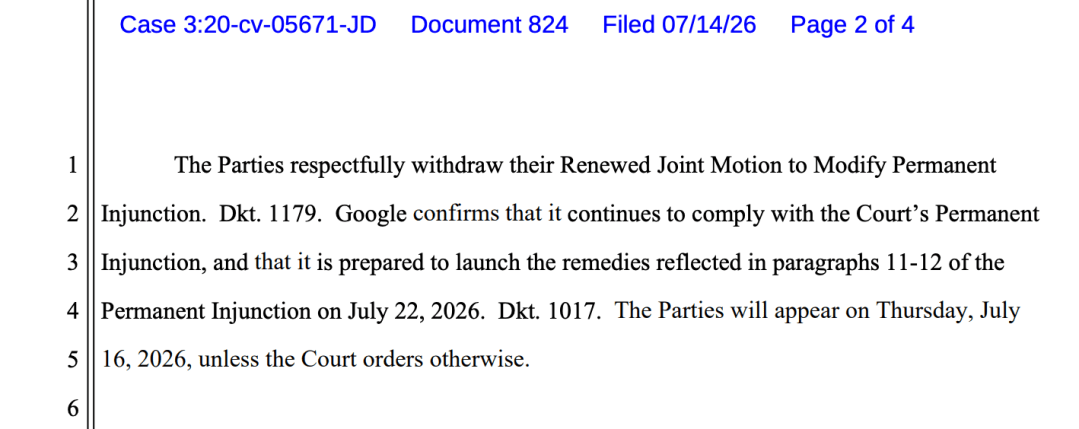
“The parties respectfully withdraw their renewed joint motion,” reads the text, adding that Google “is prepared to launch the remedies reflected in paragraphs 11-12 of the permanent injunction on July 22nd, 2026.”
Today’s legal filing in its entirety. Paragraphs 11 and 12, named above, are the ones that force Google to carry rival stores inside its own store and share its app catalog. Image: US District Court
But Judge James Donato was skeptical he should abandon his original permanent injunction in favor of Google’s proposed “Registered App Stores” that users would have to sideload — instead of simply downloading third-party stores directly through Google Play. On Thursday, July 16th, both parties were set to appear in court to argue it again, but that may no longer be necessary.

Here’s Google’s full statement on withdrawing its proposed modifications to Judge Donato’s permanent injunction, via Google spokesperson Dan Jackson:

We’ve agreed with Epic to withdraw our motion to modify the US Court’s injunction rather than prolonging this process which creates uncertainty for the ecosystem. This allows us to focus on executing our recently announced global business model evolution to deliver greater app store choice, lower prices, and more opportunities for developers and users. We remain committed to maintaining Android’s industry-leading security and fostering a competitive ecosystem where every app store and developer has the freedom to compete. In parallel, we continue to comply with the US Court’s injunction.

Google had previously announced that it would launch its sideloaded Registered App Store program in the rest of the world, beginning with the new version of Android later this year. That means there may be two different tracks for Android: stores-within-a-store in the United States and Registered App Stores everywhere else.

Google is already informing US app developers that their apps and game listings will automatically be provided to third-party app stores starting July 22nd, unless they opt out, and it’s launched a specific page for its Play Catalog Access Program for third-party app stores to enroll.

It’s not yet clear if there will be a parallel “program” for third-party app stores inside of the Google Play Store, or if companies will simply submit them the way they’d submit any other app. Technically, the court’s permanent injunction states that Google “may not prohibit the distribution of third-party Android app distribution platforms or stores through the Google Play Store,” not that it has to proactively invite them in.

For access to the Google Play catalog of apps, Google will charge stores an annual fee of $5,000 for “security and policy reviews,” and it has many additional requirements, including: stores can’t distribute apps outside of the US, have to be open to all eligible third-party developers, have “clear, non-discriminatory” trust and safety policies, and no more than 1 percent of “install attempts” can be malware.

It’s not yet clear how all the other economics around Android app distribution and billing might shake out yet — we may need to wait for more info — but Epic and Google have already set the world on a course for reduced fees and opened the Play Store to outside payments.

#3

Are you seeing a rival Android app store inside the US Google Play Store — or not?

Aptoide is the first third-party app store inside Google Play after Epic’s victory, but Aptoide CEO Paulo Trezentos tells me “I’d say 50% of people with a US account are not yet able to access it.” Most Verge staffers I’ve asked can, but a fully updated Pixel 9 review unit can’t. Google spox Dan Jackson tells me the feature is fully rolled out. Can you see it?

Does your phone show an install button?

#4

Epic v. Google: everything we learned in Fortnite court

The future of Google’s app store is at stake in a lawsuit by Fortnite publisher Epic Games. Epic sued Google in 2020 after a fight over in-app purchase fees, claiming the Android operating system’s Google Play store constituted an unlawful monopoly. It wanted Google to make using third-party app stores, sideloaded apps, and non-Google payment processors easier — while Google said its demands would damage Android’s ability to offer a secure user experience and compete with Apple’s iOS.

On December 11th 2023, the jury ruled in Epic’s favor, finding that Google has turned its Google Play app store and Google Play Billing service into an illegal monopoly, answering yes to every question in front of them about Google’s monopoly power, anticompetitive behavior, and the illegal ties between the different parts of its business. Here’s a rough summary of why the jury might have decided that way.

In October 2024, the judge issued his final, potentially monumental decision — cracking the Google Play Store open to rival stores for three years, among many other things. Google has successfully appealed all but one part of that decision. But Google and Epic have proposed a settlement that could reduce Google’s app store fees worldwide, and now, approval is in the court’s hands.

Disclosure: Vox Media, The Verge’s parent company, has filed a lawsuit against Google, seeking damages from its illegal ad tech monopoly.
Aptoide is so scammy and malware’y it’s ridiculous.

They appear to have every APK you could want—but when you hit download, you get a file with a different name and size each time. Open it and, surprise: it’s the Aptoide app store, not the app you thought you were downloading.

It’s the same ugly nonsense APKPure does. Keep stores like these away from Google Play. If Google wants to allow alternatives, let in trustworthy, open-source stores like F-Droid - not this garbage.

Why does google have to allow other stores onto their own software they own android? Apple also has a monopoly you cant even side load? Do they allow other app stores?

Yes, they do now, after they got busted by US and EU legal systems. Why should google or apple get to say what software I put on a device I paid a lot of money for? That is crazy distopian, that 2 big tech companies would have total control over everyones’ phones.

Revamped eGate app store with massive app list coming very soon. Seriously.

then make your own os, why should they have to work with competitors

They won’t have to work with competitors if they weren’t so anti-sideloading.

Who cares why should they be restricted on their own platform?

Because if I paid for a phone, it is my right do with that piece of hardware whatever I want. This is like if Ford tried to control the brand of windshield wipers I put on my truck. No! That’s none of their business.

I paid for a phone that’s restricted,
It’s your choice too buy that phone.

NO ONE is forcing you to buy it

Outside of the kosher phone market, you pretty much are forced to buy an iOS or Android device. There are not other options. Given the topic at hand, I thought is was understood that we were not talking about kosher phones.

Why?

we weren’t

kosher market is only android but that’s a side point

you bought it if you want something different build your own don’t rely on somebody else’s infrastructure and then wonder why they only let you to use their stuff its like agreeing to a job and then asking why i have to listen to the boss

Technically you are right, and all monopolies should be legal, however that would be/was terrible for people, and therefore laws were created to make monopolies illegal.

Which you can’t put onto a device with no way to unlock the bootloader. “So make your own phone”–Easy, isn’t it?

I’m literally arguing that I shouldn’t have to rely on someone else’s infrastructure, so this comment doesn’t make any sense. In fact, there is a name for this. It is called a straw man argument. If you want to argue back, then at least respond to what the actual argument is.

Are you serious? Be careful with your analogies. Are you really ok with Google being your boss? I’m not. I’m old enough to remember just 6 years ago when Google fully on board with banning people who said that people should be able to decide if they can go to church or synagogue. That’s not a boss I’m comfortable with.

Exactly. If the job analogy applies, then the appropriate term for Google is slavemaster, holding people in a relationship they don’t want to be in. Again, not sure why you are advocating for Google to forcibly control people’s phones.

It’s the same thing, I buy a product, then the company says “That expensive product that you bought, we still control it”

By the way, I would be less concerned about 3rd party app stores in Google Play if Google weren’t so anti-sideloading. They are adding more and more friction to installing apk files, with the obvious stated goal of forcing people to install only from Google Play.

you misunderstood me, you are relying on googles infrastructure by making android apps don’t make it android make your own os

so don’t buy their phones

you agreed by buying their phone

exactly its not easy but they did it they hired teams of developers and spent billions of dollars on it just like they developed their own you could also try and when you have a home enough product you could sell it to samsung to produce it or make your own phone why are you relying on their hardware also

there is a guy who got had enough and invented linux

its like i just bought a computer why do i have to use c why wont it work with micro or my own g shaped i said for it why wont it work

correct when you bought the product you knew that is what you were buying so don’t buy it next time

why should they it gives them less money

playing devels advocate and understand where they are coming from

Corporations also spent billions of dollars paying linux devs to help develop linux. IBM, Red Hat, Oracle, Amazon, Microsoft, Intel, Amd, Nvidia and many others have had whole teams of developers helping to develop linux, many of which said teams have existed for decades. By your logic I am relying on their infrastructure, and they have the right to control what software I run on Linux.

More money doesn’t make more right. This forum of all places should understand that.

I did not, neither did anyone else. No where in any purchase agreement for any android phone is there a contract that binds me as the owner (or future owners if I resell it) to using only the Play Store.

I’m also articulating a moral principle that a sale is a sale, not a lease or a rental.

if you are running their software then yes like google does linux is just the kernal

you believe its not right i don’t believe its not right so why not make money

:thinking:

how come when i bought a tesla a got an electric car i wanted a gas car or a gas oven, by buying an android phone you agreed to android and googles stuff not apples and not dietdroid, android = google = play store, you could make your own if you want something different build your own and spend on the money for your own apple did it

exactly why they cant force an update but when you buy it you buy it with what it can do how come android cant face time what write does apple have to withhold that, how come apple doesn’t have quickshare or connect well to my laptop, why does did sale have lightning i want micro did i sign anywhere i will only use micro i want my own g shared cord that i invented

There’s two angles to this: How it affects competing businesses, and how it affects consumers.

I’m going to focus on the business angle, because there it’s a lot more clear cut.

There’s no logic that says that because I invested billions of dollars, made some smart business moves, and am in a market that’s almost impossible for new competitors to enter, that I get to put everyone else out of business.

The economy doesn’t exist for people to become rich and buy islands.

It’s for people to make a living selling goods and services, and for consumers to have goods and services to buy.

I’m not saying that I’m advocating for a communist economy, but even capitalism understands that you can’t leave things as a free for all and allow giants to devour everyone else.

So for example, just because Uber decides to invent a service allowing people to order taxis from an app, and gets the world on the app, doesn’t mean that it’s okay for them to force all taxi drivers to become Uber drivers and make a fraction of what they used to for the same work.

When merchants started offerring nuts to kids doing shopping for their parents, so the kids should come shop by them, chazal said that they would ban it, if not for the fact that other merchants can do the same.

When tech giants swallowed up entire markets and then used that to take advantage of the entire world, the US government said that nothing happened.

Because for some reason our government is too weak to stand up to bullies.

But either way, Epic sued them for monopoly, and at that point the court couldn’t pretend that there’s no monopoly, and that’s how Google ended up with these orders.